
Dear Friend,
Today, we begin our second week of reading Ed Yong’s An Immense World. Last week, if you followed the pace I set for myself, you probably read about the first ninety pages, which includes the introduction and first two chapters (and a little bit of chapter three).
In my reading, there were a few things that struck me right away, such as the introduction’s focus on abundance, a nod to the importance of language in any human pursuit or concept, and the thesis of human responsibility, with some examples of how certain people are answering that call.
On Instagram today, I’m sharing a short reel about my reactions to the book’s thesis and something I found a little terrifying, so I want to focus on two other ideas in this post. The first is the importance of language.
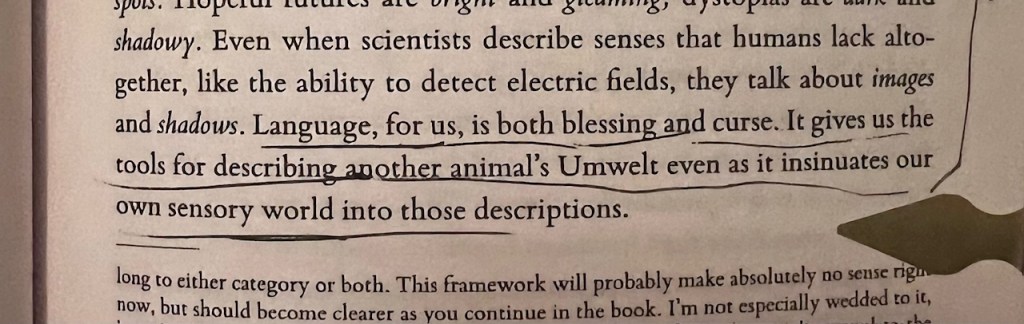
Yong writes, “language, for us, is both a blessing and curse. It gives us the tools for describing another animal’s Umwelt even as it insinuates our own sensory world into those descriptions.” What he’s writing about in this section is how often human beings use “sight” verbs to describe the other senses, and how limiting that is.
We learn that humans rely heavily on sight, and that our sense of sight is one of the strongest in the animal kingdom, so perhaps it’s natural that we do this–think in sight terms. But of course, that causes issues in a number of ways, not the least of which is for those who lack the sense of sight. It also means we fall into the trap of seeing the world through human perspective, literally, and this causes us to misunderstand, or miss entirely, what’s happening in the world around us, including how other animals and insects see the world. In a way, relying so heavily on human sight to understand the world means we lose sight of how we might be negatively affecting life around us.
Yong’s description here reminded me so much of what Ocean Vuong says about the use of violent language in relation to masculinity.
In this culture we celebrate boys through the lexicon of violence. ‘You’re killing it,’ ‘you’re making a killing,’ ‘smash them,’ ‘blow them up,’ ‘you went into that game guns blazing,’ and I think it’s worth it to ask the question what happens to our men and boys when the only way they can valuate themselves is through the lexicon of death and destruction?
Ocean Vuong
It’s no surprise to hear a poet, novelist, and English Professor like Vuong talk about how important language is to shaping ideas and to creating meaning, but it was a little surprising to see a science writer essentially making the same argument as part of his thesis on an entirely different topic. My thought: Our language is not just a response to the way we think about the world, it shapes that thinking. Language and values are inseparable, so we must take greater care in describing what we see.

The second thing that stood out to me most in these first few chapters is the notion of human responsibility and compassion. In his introduction, Yong does a brilliant job of laying out the abundance of life and all its varieties, then builds on this to include how human misunderstandings (through myopia, self-centeredness, etc.) harm the planet and its inhabitants. By attempting to make life easier for us, we’re often responsible for destroying it for others.
Compassion and understanding will help us engage with the world more thoughtfully and less harmfully. He writes, “perhaps people who experience the world in ways that are considered atypical have an intuitive feeling for the limits of typicality.” In other words, it’s often the marginalized who are capable of building the most empathy. But how can we encourage this empathy more universally? How do we make other life matter to human beings, who for centuries have been assured that, well, the planet is their dominion? This is also the central thesis laid out in Yong’s introduction, and I look forward to seeing how it might continue to be addressed later in the book.
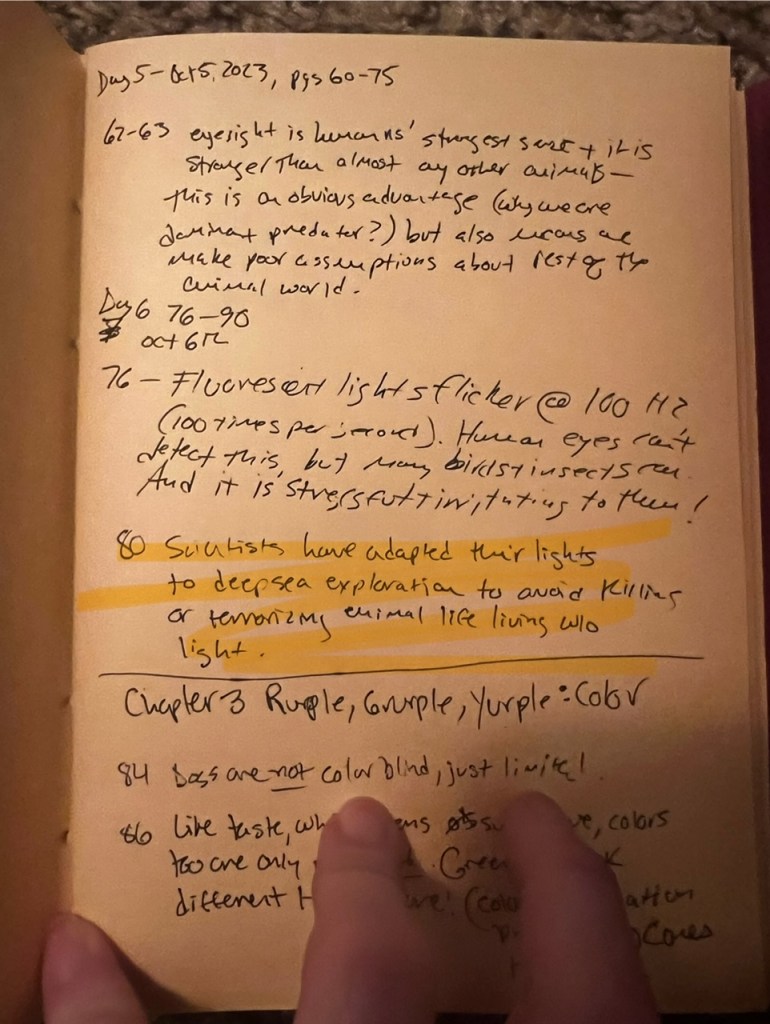
One example that I found promising comes on page eighty, where Yong is describing deep sea exploration. He recounts how a group of scientists learned that their lights were harming the deep-sea environment, sending animal life into a panic, even into madness and self-harm, because the bright lights were such a shock to the dark environment. In response, the scientists developed a more humane (there’s another interesting use of language to consider: why is treating animal life respectfully considered “humane”?) system, with softer glowing lights and lures. If this kind of compassion can be cultivated not just in the sciences, but everywhere, then maybe human beings can learn to honor the life around us rather than simply dominate it.
I’ve really been enjoying An Immense World and look forward to reading the next ninety pages in the coming week (my pace is about 13-15 pages per day). I’ll be back again on October 15th to discuss pages 90-180, which will bring us to about chapter seven. Remember to use #theCRPblog to engage with us on social media.
Meditation: “Do the best you can until you know better. Then when you know better, do better.” -Maya Angelou
With love and wishes for thoughtful reading,
~Adam
 Contemplative Reading Project
Leave a comment