
Dear Friend,
First, I’m pleased to share that our “recommend a book” form is live and ready for your input! If you want to suggest a group read for this project, please fill out this form.

This week’s reading from An Immense World covered a lot of ground, from continuing explorations into how animals perceive color, to ambitious and thought-provoking studies of pain across the animal kingdom, to sensations of heat, cold, and touch. It’s hard to believe so much information could be relayed in just ninety pages!
One of the most interesting segments, in my opinion, was the chapter on touch, and especially learning about mechanoreceptors. There are, by my count, four different types of cells that respond to tactile stimulation, and all of these together are what create the sensation of touch. Some animals, like the star-nosed mole (seen in the picture above), use surprising parts of their bodies to “touch” and “feel” their way through life, in ways that work almost like human sight. As Louis Armstrong sings, “what a wonderful world!”
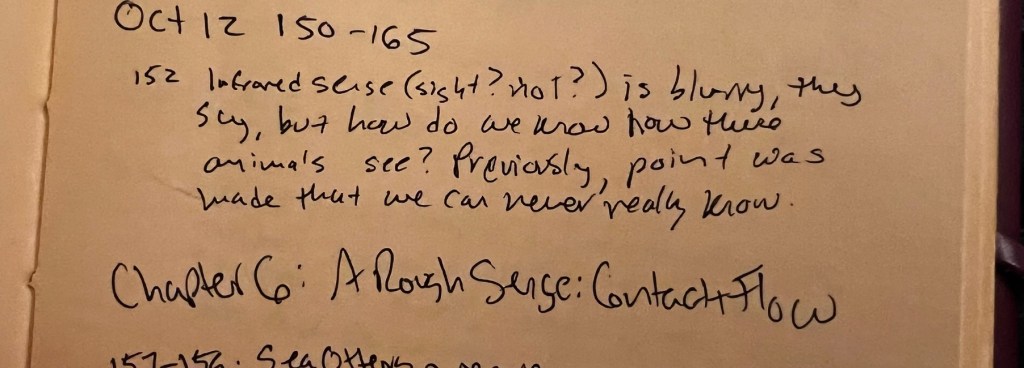
I do have one question, maybe even a concern, about a claim made in this week’s reading, though. Last week, Yong seemed to make it clear that it’s really impossible for human beings to know how another animal (or even another human being), perceives anything else, even something we might assume is uniform, like the color read. In Chapter Five, though, Yong writes that those animals who “see” with infrared sensors have blurry vision. He gives some bad examples of Hollywood films that have tried to emulate this type of vision, and one decent example (Predator). I wonder, how can we know that what these animals see is blurry? Isn’t that contrary to the idea that we can’t really know how sight, colors, heat, pain, etc. are experienced by another living being outside our own experience? Curious!

The chapter on pain was also a riveting one for me. At two points in my life, once when I was very young (high school), and once not that long ago, I was a strict vegetarian for moral reasons. I’ve never been comfortable eating animals when there are plenty of alternatives that don’t take life, but which allow for healthy eating/nutrition. Not long ago, I added birds and fish back into my diet because I had been struggling to get certain nutrients, which caused some pretty severe health issues.
After reading about studies in pain across the animal kingdom, I’m resolved to return to a vegetarian diet and to find ways to meet my health needs elsewhere. This is also in keeping with my movement toward Buddhism and a Buddhist way of living. Sometimes, it seems, it’s a good idea to trust one’s own instincts (some might say, “listen to your heart”) when considering questions like these.

Ed Yong’s An Immense World has been a real journey. We’re at the half-way mark, and I’m looking forward to revelations yet to come. Our planet, and all its life, is such an overwhelmingly complex treasure. Studies like this one really encourage a person to take more care with their home and neighbors.
Meditation: “I stopped eating meat, fish, and fowl about ten years ago. Part of it has to do with the animals; it’s hard to eat something you’ve seen walking around. I don’t want to eat anything that has a mother.” –Fred Rogers
Love,
~Adam
 Contemplative Reading Project
Leave a comment