
Dear Friend,
Today, we end our contemplative reading of Ed Yong’s meticulously researched and wonderfully written biography of the animal kingdom, An Immense World. I don’t know about you, but I found the journey remarkable and rewarding, and I’m sure I’ll think about what I’ve learned often in the years ahead.
In the last quarter of the book, Yong explores animal senses such as magnetic fields, he writes about the miracle of animals who use all of their senses combined to engage with their Umwelt, and he ends by returning to human beings and both our place in this kingdom, and our responsibility to it.
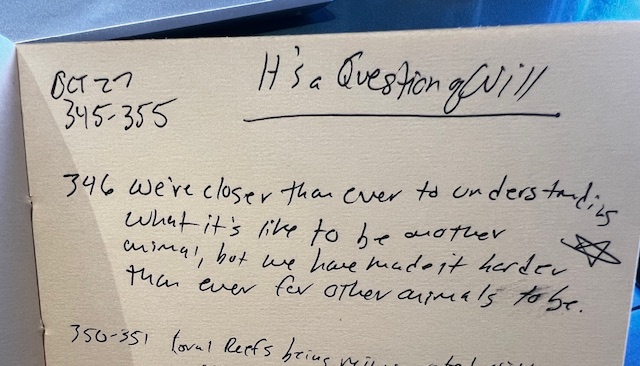
I was particularly drawn to that last part. In chapter thirteen, “Save the Quiet, Preserve the Dark,” Yong explains just how severely we affect the animals we share this planet with through light and sound pollution. He suggests that some simple changes, like using red lights instead of white ones, could reduce disruptions to migratory patterns and even save thousands of animals’ lives each year. But he wonders whether we human beings have the capacity to care enough to make even the simplest changes if it doesn’t seem to directly benefit us. “It’s a question of will,” he says, and I wonder, too, if we have it in us.
I sometimes think about what the air and skies were like during the pandemic shutdown, so clear and clean. I think about the soft sounds that returned to us when our loud and harried bodies were slowed, and I wonder, does anyone else remember that? Don’t we want it back?

Yong also helps the reader appreciate how special human beings are. As he reminds us, we’re the only animal capable of understanding what life might be like for another species (and even another human being), but “the study of animal behavior is plagued by human behavior” (317). Our personal biases, our jealousies, our ego and desires, and our limitations, all get in the way. One wonders how we might, as a species, learn to bring all animal life into our Umwelt, our culture and experience, and learn to respect it and care for it as we would our human neighbors and neighborhoods.

Yong concludes the book with a call to action, something I had been wanting more of throughout, if I’m being honest. As he so aptly suggests, we haven’t been kind to our animal cohabitants. We haven’t even been considerate. The last two chapters end by giving the reader more to think about regarding their (and all of our) responsibility to this planet and its inhabitants.
Every animal and insect explored in the book–and by extension, every animal and insect in the world–is unique, wonderful. But human beings are special. We can perceive these wonders. We can ask questions about them. And we can choose how to interact with all of them. That’s extraordinary.
Next month, we turn our attention to a new text and new experience: Mary Oliver’s Long Life. I’ll post more about the book, and my reading/posting schedule, on November 1. I hope you will join us!
As always, remember to use #theCRPblog on social media to find our group.
Meditation: “You do not have to be good. You do not have to walk on your knees for a hundred miles through the desert, repenting. You only have to let the soft animal of your body love what it loves.” –Mary Oliver
In love and readership,
~Adam
 Contemplative Reading Project
Leave a comment