
Dear Friend,
What a joy it’s been to visit with Mary Oliver. She, like Ocean Vuong, Kurt Vonnegut, Virginia Woolf, and select others, always makes me feel like I’ve come home again.
I think this final part of Long Life might have been my favorite, since it was the most personal and intimate. While each part is autobiographical, much of the ruminations are self-looking-outward, toward nature, toward life, toward inspirations. Here, in “Dust,” Oliver seems to be revealing more about herself, and as always, she has a remarkable way of sharing. Take this description of sunrise, for instance:

I’ve had my breath taken away many times by sunrise, especially those here in the American Southwest, where I can watch it breaking over the eastern mountains, but Oliver’s picture is almost more beautiful than the real thing.
Or take this excerpt from one of the many poems in this part, “Sand Dabs, Seven”
“Plain as a needle, a poem may be, or opulent in the shell of the channeled whelk, or the face of the lily, it matters not; it is a ceremony of words, a story, a prayer, an invitation, a flow of words that reaches out and, hopefully, without being real in thew ay that the least incident is real, is able to stir in the reader a real response.”
It’s as if someone asked her, “Hey, Mary, what is a poem, anyway?” And this is her response. Who could ask for more? I was once interviewed for my perspectives on poetry and asked a similar question (“How does a poem begin?). I thought my answer was fairly strong, but maybe I should have just pointed to Oliver’s.
“Dust” really is a fitting conclusion to this creative memoir, from its title to its themes, many of which focus on a variety of kinds of “endings,” including loss. I thought it was appropriate that she included quite a few more poems in this last part than in others, too, since that is her primary mode. It’s a sensible place to part with the reader, and perhaps encourages readers to search out more of her creative pieces.
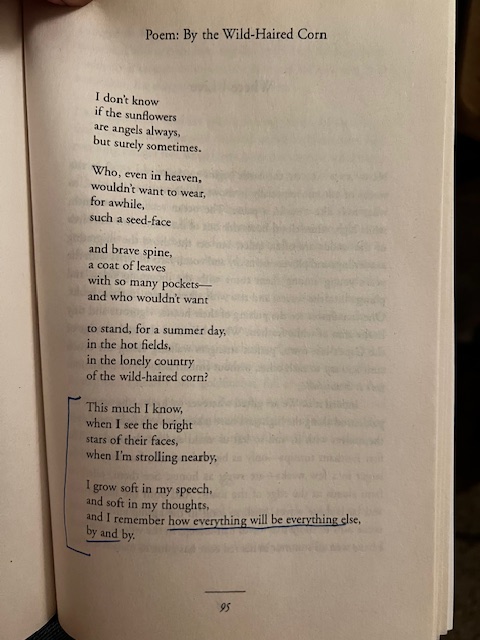
My favorite poem from the book, or at least this chapter of it, is “By the Wild-Haired Corn.” I especially responded to the ending, where she writes, “This much I know, / when I see the bright / stars of their faces, / when I’m strolling nearby, / I grow soft in my speech, / and soft in my thoughts, / and I remember how everything will be everything else, / by and by.”
Despite my attempts to “be soft” in life, I often need these reminders, and how beautiful to see her mention “soft in speech” and “soft in thoughts.” I know I’m sometimes better at one of these than the other. I offer my gratitude for this gentle encouragement to honor both.
Next Month

I hope you’ve enjoyed our journey through Mary Oliver’s Long Life. On December 1st, we’ll begin our reading of Charles Dickens’s classic, A Christmas Carol. It’s also time to announce our January selection.
I’m pleased to share that we will begin the new year with The Book of Joy by His Holiness the Dalai Lama and Archbishop Desmond Tutu! Remember, you can always submit your recommendations for future CRP reads.
Meditation: “To be careful with people and with words is a rare and beautiful thing.” -Benjamin Alire Sáenz
Love,
~Adam
Twitter (X); TikTok; Threads; Instagram; Facebook; Support Us.
 Contemplative Reading Project
Leave a comment