
Dear Friend,
Although we’ve only read Stave One of Charles Dickens’s A Christmas Carol, I’m already grateful we chose this one as a contemplative read. I thought I knew this story intimately, having read it many times and seen its adaptations countless more, but already in these first pages, I’m connecting to it more than ever. I suppose that’s the beauty of slow reading!
Something that caught my attention from the get-go is that the story is being told from the first-person perspective. I know this is common in Victorian literature, as it creates a sense of authenticity by presenting the tale from an eyewitness account, but I had no recollection of A Christmas Carol being narrated this way! It makes a lot of sense when we consider some of the first promises. That something “wonderful can come of the story,” for example.
We can trust that, can’t we, when the eyewitness tells us its true? And since the story begins with a death (“Marley was dead, to begin with”) and is followed by depictions of a truly callous, heartless man, it helps to know that a happy ending has been foreshadowed.
Something I’m curious about is the promised visits from the ghosts. Marley’s spirit tells Scrooge that he’ll be visited by three ghosts over three nights, but all my memories are that the ghosts visited him in the same night, every couple of hours. Am I misremembering? Or will this be resolved somehow upon Scrooge’s third awakening? A return in time, perhaps? I really don’t remember how this is tied-up, and the initial design had me feeling strange because I also recalled the story ending on Christmas day. Now, how can that be, if the story begins on Christmas Eve and Scrooge is to be visited over three nights? I’m excited to find out!
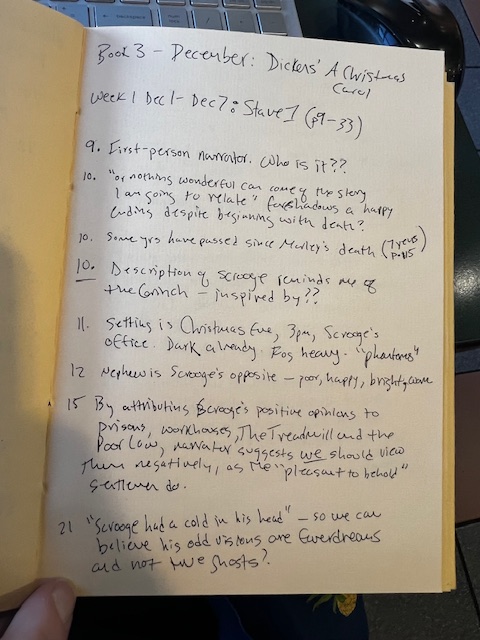
There are a couple of literary allusions, forward and backward in time, that also had me chuckling a bit. The first comes in the long description of Scrooge’s character. There’s a listing of all his terrible attributes, and it reminded me so much of the song, “You’re a Mean One, Mr. Grinch.” Now, I don’t know if the Grinch was inspired by Ebeneezer Scrooge, but it seems possible, doesn’t it? And if the song was directly inspired by this passage in Christmas Carol, that’s ingenious and delightful!
The other allusion I notice comes near the end of Stave One. Just before Marely appears, Scrooge’s “glance happened to rest upon a bell, a disused bell” that once communicated with another chamber in the house. It soon begins to ring, softly and then loudly, which sets off every other bell in the house. I couldn’t help but think of John Donne’s bell, which portends death and which “tolls for thee.” Is Scrooge being warned?
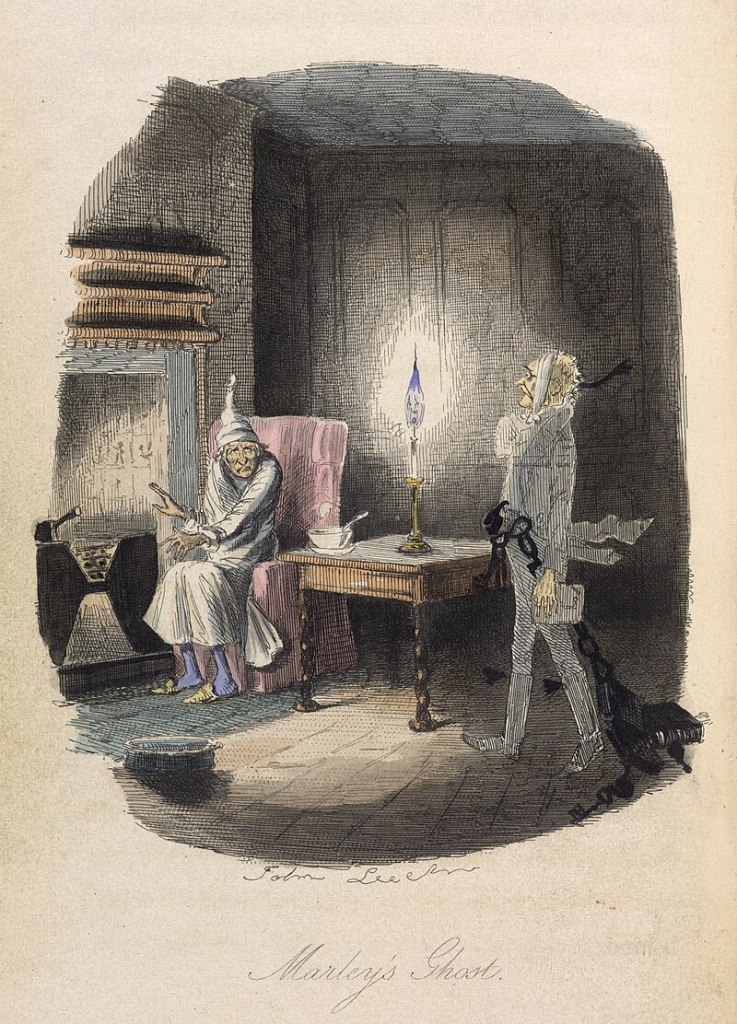
The most moving scene in this first Stave comes just before the end of it, when Marley dissolves and Scrooge can briefly see into the mists of hell. He witnesses men and women, alone and in groups, tortured not by the deeds they committed in life, but by the newfound compassion and awareness they gain in death. All of them discover the consequences of their actions, all of them understand how they could ease the pain and burden of the living, and all of them are unable to help. True hell, it seems, is knowing what is right and good, but to be powerless to do it.
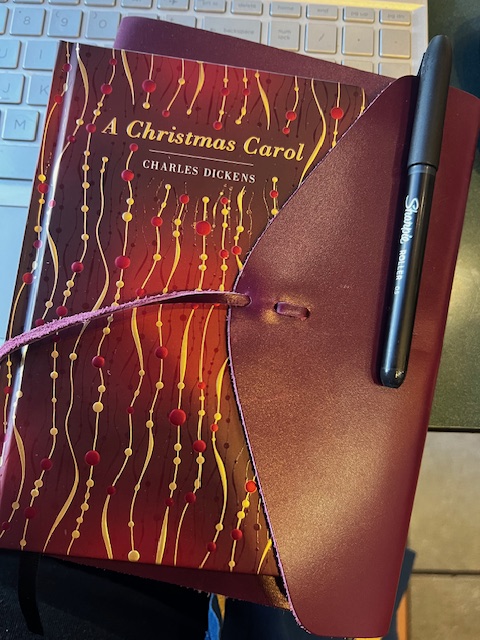
I’m thoroughly enjoying my return visit to this spooky, funny, atmospheric little world. Dickens’s concern for humanity is at the forefront of all he wrote, but the measure of love and consequences, of interconnectedness, is perhaps best suited to this Christmas tale. By the way, I have to highly recommend the Chiltern edition that I’m reading. The illustrations are gorgeous and add much to the reading experience.
Meditation: “Mankind was my business The common welfare was my business; charity, mercy, forbearance, and benevolence, were, all, my business.” -Charles Dickens
With love and thoughts for peace in Palestine, and everywhere,
~Adam
 Contemplative Reading Project
Leave a comment