
Dear Friend,
And so, we return to poetry. Well, sort of.
Theresa Hak Kyung Cha’s Dictée has been described as a novel by some, as poetry by others. “Genre-bending” seems to be the most common and perhaps most apt description. I think what might be most important to know is, as The New Yorker says, Theresa Hak Kyung Cha makes a “radical refusal to explain herself.” Doesn’t that sound exciting?
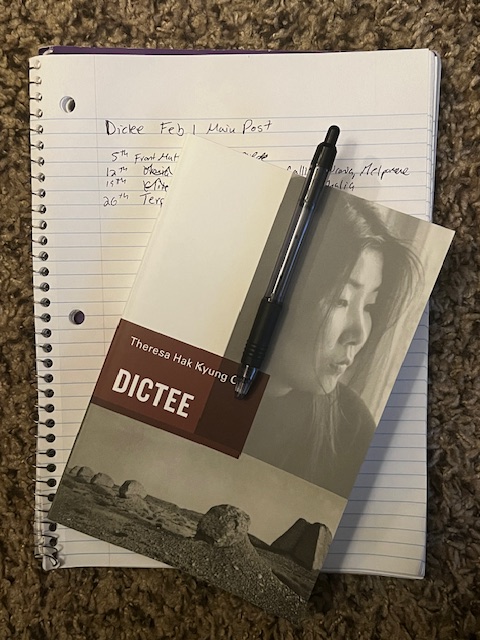
Truth be told, I don’t know much about this one except that it was published in 1982 and that, just a few days later, the author (a poet, filmmaker, and artist), was murdered. I also know that it’s a book Ocean Vuong has remarked on countless times, and that alone makes it a necessary read for me.
I turn to the publisher, then, for a more thorough description: “A classic work of autobiography that transcends the self, Dictée is the story of several women: the Korean revolutionary Yu Guan Soon, Joan of Arc, Demeter and Persephone, Cha’s Mother (Hyung Soon Huo, a Korean born in Manchuria to first-generation Korean exiles), and Cha herself. The element that unites these women is suffering and the transcendence of suffering. The book is divided into nine parts structured around the Greek Muses. Cha deploys a variety of texts, documents, images, and forms of address and inquiry to explore issues of dislocation and the fragmentation of memory. The result is a work of power, complexity, and enduring beauty.”
Sharp eyes might have noticed that the publisher describes the book differently from any other description I’ve seen so far: not poetry, not novel, but this time, “autobiography.” And yet, an autobiography of “several women.” How can this be? (Or are all of these women Cha herself?) I’m excited to find out!
Why Contemplative Reading?
Contemplative reading asks us not just what we’re learning about the book in our hands (or ears), but what we’re learning about ourselves through the experience of reading it. The aim is to create deeper awareness of ourselves and understanding of others. It is often described as “holistic,” but also as “heart-knowing.”
Heart-knowing. Doesn’t that sound nice?

The Plan
As the description above notes, this book is divided into nine parts, each titled after a different Greek Muse. There is also a section of front matter and back matter, however, that look to me to be important to the book overall, so I’m including these in my reading plan and bringing the total number of parts two eleven. My plan will be to read two or three at a time and post about them each Monday.
In other words, my posting schedule will look like this:
- February 7: Front Matter and Clio
- February 14: Calliope, Urania, and Melpomene
- February 21: Erato, Elitere, and Thalia
- February 28: Terpsichore, Polymnia, and Back Matter.
As always, I don’t plan on doing any other research, since this is not a study but a contemplation. That said, this might be one of the more challenging books so far in the contemplative reading series, both because of its creative design but also because of my lack of context. I shall treat it as an adventure!
Reading & Responding
Each set of reading will guide my responses here on the blog and on social media. I might sometimes share the most provocative line or passage, and what it makes me think about. Other times, I might ask questions about the reading, things I’m wondering about or confused about. And still further, I might compare what I’m reading to what it reminds me of from other readings or experiences. I don’t want to give too much guidance about how to read, except to say, read attentively, read slowly, and listen to yourself. What thoughts and feelings arise as you’re reading? Write them down and give yourself some moments to reflect on why you’re thinking what you’re thinking, or why you’re feeling what you’re feeling.
I will also be interacting on social media, of course, and may share micro-thoughts and favorite quotes or reactions on Instagram, Threads, TikTok, and Facebook. I encourage you to join these conversations or leave your thoughts in the blog comments.
On social media, please #theCRPblog.
Meditation
“Is that what art is? To be touched thinking what we feel is ours when, in the end, it was someone else, in longing, who finds us?” -Ocean Vuong
Love always,
~Adam
 Contemplative Reading Project
Leave a comment