
Dear Friends,
They say that pain is good for creativity.
There’s a long mythology surrounding “the tortured artist,” so much so that the idea has become a cliché. The myth also becomes a problem, because many young aspiring artists believe they must seek out pain to become great, and that’s certainly not healthy (and it is most likely untrue.) Long ago, I gave up believing that there was much correlation between a painful life and a creative one, but it’s hard not to fall back into that belief after reading a chapter like “East” in Joy Harjo’s memoir.

This section begins with Harjo describing her mother’s relationship with the man who would become Harjo’s stepfather. While courting her mother, the man was all smiles and charm, but as soon as they were married, his true colors shown. The abuse they all suffered at the hands of this man is intolerable to read about, and hard to imagine living through. What makes it worse is that there was no way to get help. Joy Harjo describes just what a failure law enforcement was for women and children in this situation at this time, but especially for women of color who had married “a white man with a job” (60). In other words, who in authority would believe them, and what resources would they have to leave and thrive, even if they could?
There are some specific details about the abuse they suffered, but as a skilled poet and storyteller, Harjo makes the feeling of it come alive through language and emotion, rather than by recounting exact experiences. For example, she describes this point in her youth this way: “Imagine this place in the story as a long silence. It is an eternity of gray skies” (63). It was not a happy childhood. And yet, her connection to life and the living, her innate abilities and her place in the world, remained strong. Even when she lived within the gray, she writes, she “felt the presence of the sacred” (64).
If pain or suffering and creative ability are not correlated, what about empathy? I’ve been thinking a lot lately about whether our experiences affect how we relate to others. I used to believe there was a direct connection: People who suffer understand suffering, so they respond to the suffering in others and try not to be the cause of it. But as time goes by, I have started to question that assumption. There’s also been much said about the act of reading and how reading (especially fiction) can enhance a person’s empathy. Is this true? Harjo seems to have been an empathetic person in her youth and remained so as she grew up, as evidenced by her relationship with her mother, by her reaction to the dead pet fish, by her friendships at boarding school.
So, did her difficulties at home build those traits, or would they be there regardless? Would a different person respond completely differently to the same experiences? And how does all of that, especially in our youth, influence the person we become? Does reading about experiences like these help me, and others, empathize with people unlike ourselves, and if so, does that translate to the way we interact with the people we encounter in our daily lives? These are questions I can’t help but wonder about after reading “East” in Crazy Brave. Why do hard things make some of us softer, while making others harder?
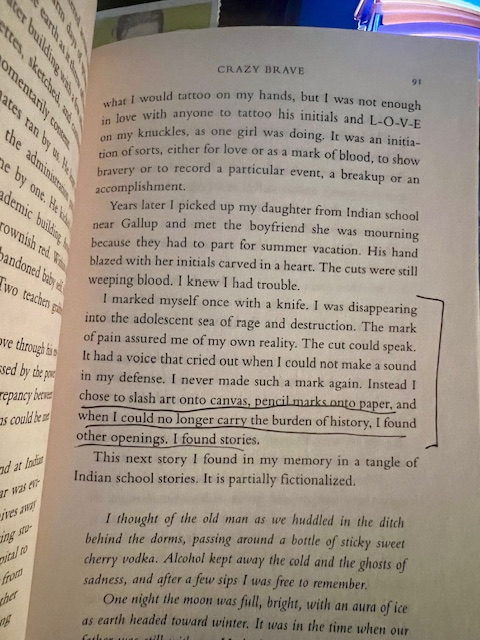
Harjo offers one insight into the question of reading and writing, at least. She mentions that when the pain became too overwhelming, she once tried alleviating it by cutting herself with a knife. It didn’t help, so she found another way. “I chose to slash art onto canvas, pencil marks onto paper, and when I could no longer carry the burden of history, I found other openings. I found stories” (91). The rest of this chapter, then, is an autobiographical short story where the narrator/Harjo explores and tries to work through some of the horrors of her own life and the lives of others. In the act of writing, she finds release, and in the act of reading, perhaps we learn something, too. Compassion. Patience. Perseverance. Hope.
Maybe empathy is learned, or maybe it’s innate, but regardless of our capacity for empathy, the act of sharing and experiencing stories beyond our own is a way of knowing, and through knowing, growing.
Meditation
“Boiling water will soften a potato but harden an egg. You can’t control whether you’re a potato or an egg, but you can decide to play a game where it’s better to be hard or soft.” -James Clear
May you be free to feel, with love,
~Adam
 Contemplative Reading Project
Leave a comment