
Dear Friend,
“Music’s my religion.”
So begins James Brandon’s young adult historical fiction novel, Ziggy, Stardust & Me. You might recall my mentioning that this is one of only two books in this project that I had already read. It’s always a little nerve-racking to return to a beloved book, but even more so when you’re encouraging so many others to read along with you. At this point, while there’s a lot that might give certain readers pause, I’m mostly being reminded of why I loved this one in the first place: music, people, and history.
The first element that stands out to me is the use of music as a major theme. This is something I see a lot of in young adult novels, and in fact my first novel was heavily inspired by music (and film). I don’t know if it’s just because music is so important to me personally, or because it’s one experience that is near universal across humanity. We all have our preferred genres of music, and most of us know what it means to be lost in a favorite song or to be in the presence of our favorite singer or musician. These things change us, if only for a moment. And many changes over many moments have the potential to make change permanent, especially when we’re sharing the experience with others.
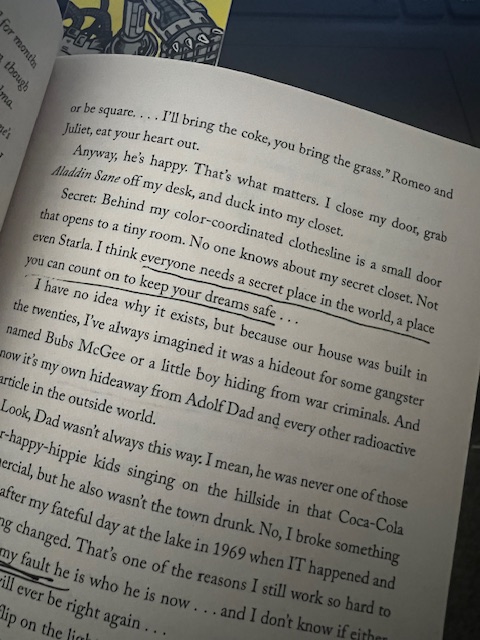
My best friends and I bonded over music and have maintained a twenty-year friendship. We still visit one another, still talk to each other regularly, and we still send one another music. The main character, Jonathan, and his best friend, “go to church” by watching Soul Train. Jonathan, our teenage protagonist from a little town outside St. Louis, finds safety and escape in music, and a hero in Ziggy Stardust. But does he want to worship Ziggy, or does he want to be Ziggy? I’m not sure he’s figured that out yet.

Another reason I turn to stories is for their people. Call it character or character development, characterization or whatever, I want to witness and experience what these people do. I want to learn from them, feel with them, grow with them. Any good novel, to me, must have amazing characters, ones who are complex and flawed, and who develop over time. We’re still early in Ziggy, Stardust & Me, but I can already sense the changes that our protagonist, Jonathan, is going through. He has suffered at least two traumatic experiences in his young life, the first being the loss of his mother and the second being only alluded to thus far, but something having to do with his sexuality. He’s also in the midst of experiencing a persistent trauma, living with his alcoholic father who is, if not abusive, judgmental, spoiled, and opportunistic.
Jonathan’s two friends so far, Starla and Web, are different from him in many ways, and different from each other. They’re living disparate lives and yet they come together over certain shared interests and experiences. One thing Jonathan may have to learn is how to love someone and be separate from them, which is a mature journey indeed. Starla will be leaving him soon for the summer, and it’s clear that Jonathan is not used to being without her and is uncomfortable with the idea. But for a boy who is different, bullied at school and terrified at home, a boy being treated dramatically for a “sickness” that is only his personality, a boy who cannot experience love without physical pain, it’s a lot to lose the one person you’ve come to rely on.
Which brings us to the third most compelling feature of this novel, its history. While there has been an increase in LGBTQ+ themed literature over the past two decades, there’s a range of what those stories choose to focus on. Historical fiction is such an important avenue for these stories because it allows readers to witness two important truths: the first, that LGBTQ people have always existed, and the second, that what LGBTQ people have been forced to suffer should be insufferable, and should be remembered.
Ziggy, Stardust & Me is the only novel I can think of that portrays the coming-of-age story for a gay boy growing up in the early-1970s. This is a time when homosexuality is still considered both an illness and a crime. The early pages of Jonathan’s story are teeming with fears. Jonathan is afraid for his safety, afraid for his sanity. He’s worried about being arrested like his uncle or committed to an insane asylum. These are realities of the LGBTQ historical experience that most contemporary audiences do not know. They never learned about it, and as attacks on LGBTQ topics and history continue to ramp up, it’s hard to imagine that many new audiences will come to know or understand any of it. It’s a shameful past, but there’s no shame in learning about it and finding empathy from it. In fact, I think that’s the kind of heroic progress that saves societies.
It’s not just LGBTQ history being presented, though. There are mentions of the women’s rights movement, of the passage of Roe v. Wade (particularly striking to a contemporary reader, now that Roe has been struck down), and of the occupation at Wounded Knee, all of which occurred early in the year this story is set, 1973. I love a book that edifies. I’ve said so many times, and it remains the case, especially when the story itself is so interesting, told so well and through such compelling characters. Young adult novels are an excellent vehicle for these historical themes because they allow the reader to come of age–come to knowledge–right along with the main character, without embarrassment for not having known something that perhaps we should have.
Jonathan, like many readers, is looking for safety. A safe place to be and to learn. When he looks into Web’s eyes and finds them to be “black hole vortices that spaghetti [his] brain,” I know just what he means. The real mystery is that falling in love isn’t about anyone else; it’s possibly the greatest discovery we make about ourselves.
I think that’s true when we fall in love with a book, too.
Meditation
“You only have right now to be kind. After that, it’s gone; you’ve lost your chance.” -James Brandon
May you feel safe,
~Adam
 Contemplative Reading Project
Leave a comment