
Dear Friend,
All good things come to an end. Just as David Bowie retired Ziggy Stardust on July 3, 1973, so we conclude this month’s reading selection and look ahead to a new chapter in our journey.
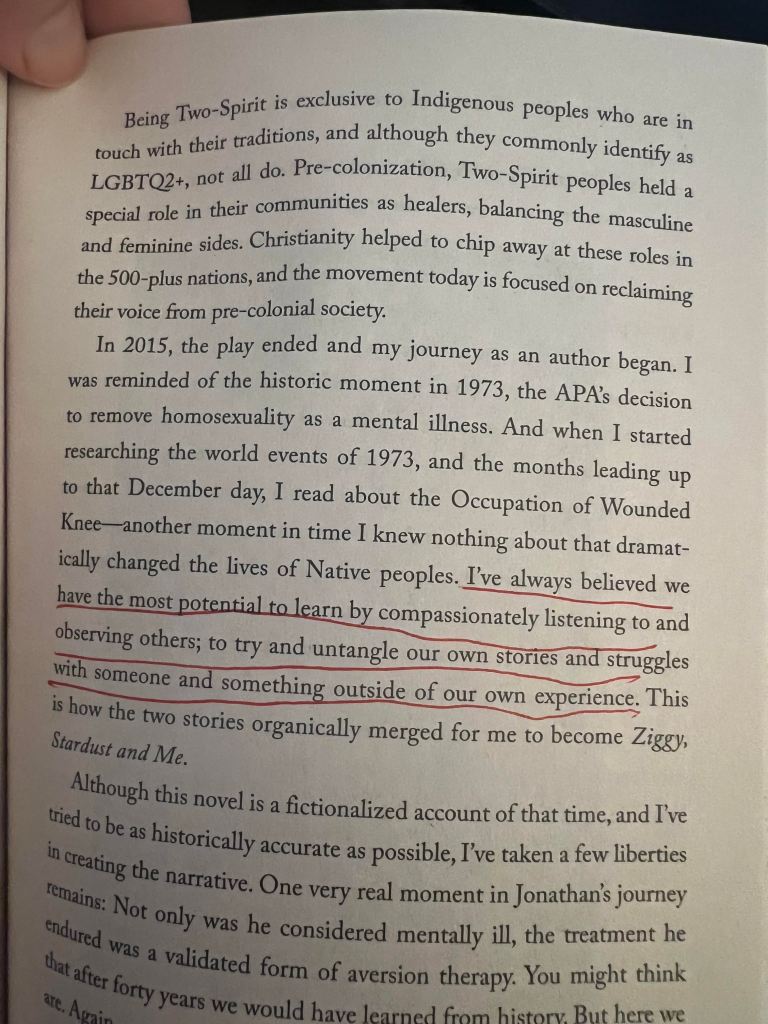
In the early part of the week’s reading, Web explains to Jonathan about two-spirit people in the Native American tradition, and it’s as touching and beautiful an interaction as I remember from my first read five years ago. This book wasn’t my introduction to two-spirits, but it was the first time I encountered it in fiction, and I think part of why the book became and remained such a favorite for me was because of the sensitive and reverent way the concept is treated by James Brandon. He explains later in the author’s afterword how he learned about the history of two-spirit people and what it meant to him. That love was translated clearly and effectively into the story and left me both heartbroken and hopeful. To imagine a culture where queer people are held in the highest esteem for their unique perspectives? It almost sounds like a fantasy world, and yet it was, and is to some extent becoming again, a reality.
This third part of Jonathan’s story is all about his taking ownership of his own life, learning to accept himself and even like himself, and finally, standing up for himself and for Web. It’s a long journey to travel in just about two months, but one images it was the combination of being independent from Starla and meeting Web that helped nudge him toward this independence and personal growth.
It’s important for Jonathan to be coming into his own at this point in his life, because the two people he had been relying on, his father and his therapist, both disappoint him, as does his mother, who is long gone and acting only as a figment of his imagination, but when he realizes this, it is, in a way, like he’s losing her again, too. Every other new person in his life proves to be a serious disappointment. His father’s girlfriend, and her brother, are despicable people who put Jonathan in very real danger. I do think Jonathan’s therapist has been on his side from the beginning, and trying to do the best she can for him given the knowledge she had at the time, and the prejudices with which she and all within the system were working. She’s also the only adult in Jonathan’s life to show any growth or change, and to admit her mistakes. So, while Jonathan does not forgive her, I think she could have been an ally for him moving forward, though it’s hard to fault his decision. It also might be necessary for his ability to take control of his own life.

That ability is demonstrated quite movingly twice in this later section. The first instance is after Jonathan and Web spend the night together. It’s a touching moment for the two, but especially Jonathan, who doesn’t just work through the psychological pain he endures as a fallout from shock/conversion “therapy,” but in fact becomes able to enjoy the feeling of being with Web. He sees Web in this moment together in a kind of angelic light, the way we often do with lovers in sensitive moments, but he doesn’t idealize Web. Instead, he says, “I can fix what’s broken in me.” That I is so important. In a moment of partnership and the true budding of an intimate relationship, it would be easy for someone in pain to look at this other person as their savior, but Jonathan realizes that he’s the one doing the work. He will heal himself, and that’s what makes him open to being with another person romantically.
Later, as he’s thinking about the attack that he and Web’s family endured at the lake and working through things in his own way by imagining he’s having a conversation with his mom, he realizes, “it was me all along.” He has been his own strength, his own conscience. All of this unfolds in the context of the time. That Brandon integrates momentous historical events in music, society, and politics, into Jonathan’s growth, is beyond effective. It creates a coming-of-age story for both the protagonist and for American culture.
I hope you enjoyed reading Ziggy, Stardust & Me with us this month. In August, we’re turning to Zen and the Art of Saving the Planet by Thich Nhat Hanh. Join us on August 1st for a brief introduction to the book and author, and a schedule for reading & responding.
Meditation
“I’ve always believed we have the most potential to learn by compassionately listening to and observing others; to try and untangle our own stories and struggles with someone and something outside of our own experience.” —James Brandon
May you hear and be heard,
~Adam


 Contemplative Reading Project
Leave a comment