
Dear Friend,
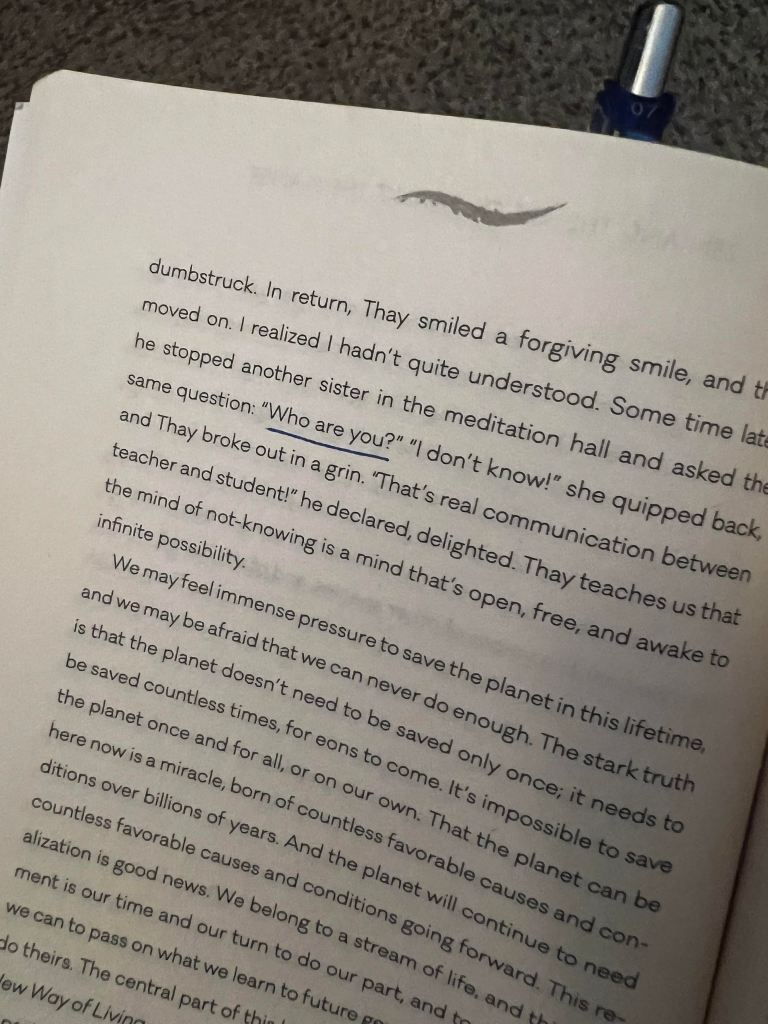
“Who are you?”
There’s a reason that the Caterpillar has always been my favorite character in Lewis Carroll’s Alice’s Adventures in Wonderland. He’s the only one that asks the important question, the one that gets to the heart of the novel. Why has Alice fallen through the rabbit hole, after all, if not to begin the journey of finding herself?
About halfway into this first section of Zen and the Art of Saving the Planet, Sister True Dedication asks the same question, but it’s not intended to make one think of their own individual identity. In fact, it’s the opposite. We are the sum of our parts, of everyone and everything that has come before us and of everyone and everything that ever will. We quite literally would not exist without the millions of interactions required, across all of time and space, that allowed our being. So, when we watch the sunset, whose eyes are seeing it? We bring to our every experience an unfathomable breadth of history and consequence.
The Trouble with Expectations
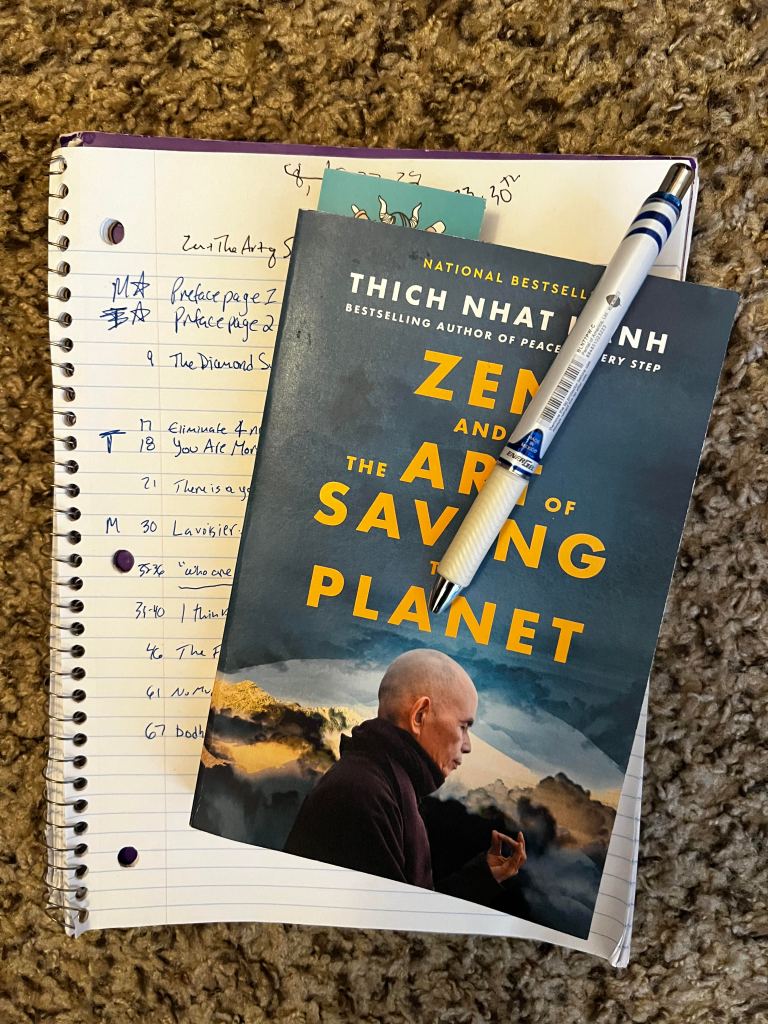
I have a friend and fellow reader who shared that they had tried to read this book but couldn’t get into it. As someone who has read quite a few books by Thich Nhat Hanh, I fully expected to “come home” to this one, but I understand now what my friend meant. I entered this book assuming it would be a treatise or step-guide to ecological action. From a Buddhist perspective, sure, but still a kind of practical approach toward being or becoming a climate and environment activist. So far, that is not the case, and it’s a good reminder to approach everything as “bodhicitta,” or one with a beginner’s mind.
Instead of a step-by-step guide to climate activism, this is a collection of Thay’s teachings on being-in-the-world. Its primary focus so far seems to be on eliminating four notions: the self, the human being, living beings, and lifespan. If we can come to understand that we are not one single self, but the collection of all that was required to create us, and if we can begin to see all life from all perspectives, including the non-human, and if we can move even beyond the focus on living beings to realize that those before us and those who will come after us are also part of this “me” who lives now, then we’re on the way to a consciousness that truly encourages “saving the planet,” because we begin to see the planet is me, too, and that I exist in all times and all spaces. In other words, the fate of the world matters to me even after my death, because my life will outlive my body.
Looking Deeper
The essential premise is this: If I am you, and you are me, and we are the planet, and the planet is us, then we will do no harm, because why would I harm myself? This is where the Buddhist concept of karma enters the picture, but it’s not quite the karma that people use or think about colloquially, that kind of mystical force that causes bad things to happen to bad people (and it is usually the bad actors that seem to be the recipients of “karma” when we talk about it conversationally.) Instead, this perception of karma is sensible. Every action has its effects. Whatever I think, do, or say, will ripple into my mood and actions, and the moods and actions of anyone with whom I interact. It’s perhaps another way of thinking about “the golden rule”: to treat others as you wish to be treated. This isn’t just kindness for kindness’ sake, but because of the real consequences of doing harm.
Imagine I say something unkind to my barista, and it troubles her so much that she has a bad day, making all kinds of mistakes, so she gets reprimanded by her boss and by customers whose drinks she’s messed up, and then she goes home in that bad mood, feeling hurt by what I said but also by how poorly she performed and by the way others yelled at her, and now she’s in her apartment with her kids–can she be cheerful and warm? Can she keep all of that stress and sadness and pain from crossing into her family life? It would be a lot to ask of anyone. But if she fails, as most of us would, it’s no longer just her who is negatively affected, nor the customers whose drinks were ruined, nor the boss who had to discipline her even though he’d rather not, it’s now her kids, too, who may at the very least sense her distraction or distance, and at worse become the brunt of her frustrations. There’s one silly, thoughtless act that I took, and how it could harm not one, not two or three, but easily a half dozen or more people in a single day. Now think about how many people those people interact with.
In this way, we can “save the planet” by being mindful with our thoughts, our words, and our actions. There may be concreate climate and environmental steps to come in the next section, or there may not, but I think the point so far is that it begins with us and what we choose to do, every single day.
Meditation
“Nothing is created, nothing is lost, everything transforms.” —Antoine Lavoisier
Love,
~Adam
 Contemplative Reading Project
Leave a comment