
Dear Friend,
Sometimes I’ve wondered about memoir as a genre. Why do we read a segment of some individuals’ stories? And who decides to share theirs? Isn’t that, well, egotistical?
But then I step into a memoir whose story is more than the individual’s and whose prose is poetry, and I blush at the questions I used to ask.
Blood Full of Ghosts
“I knew that music now. Its strain seemed to run through the lives of so many of the men I knew – a sort of counterpoint, shimmering in the background, rising and falling from the melody.”
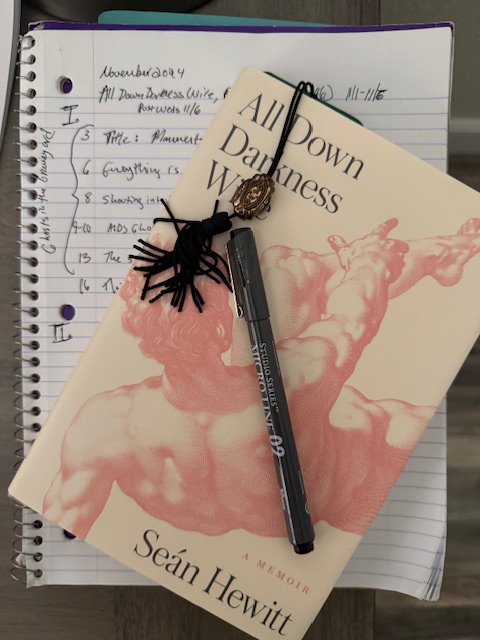
Already in these first two chapters, which encompass only about 40-pages of this two-hundred-plus memoir, Hewitt has entered “that endlessly linking river” that is the sorrowful history of gay men (16). It was a strange experience, reading this first chapter on the eve of the 2024 presidential election, and then somehow pushing through the next chapter the day after. I can’t help but think about “all the others who had entered the darkness and struggled to leave it” and of what darkness looms ahead for too many of us. After the 2016 election, LGBTQ+ people found themselves quietly but immediately erased from any mention by the federal government. How fickle is the current of that river, and how rapidly it moves.
Some of the experiences Hewitt writes about his youth are uncannily familiar, and I wonder just how many of us have shared such intimacy from afar, without ever knowing it. He writes about his first time going to donate blood, and a flood of memories washed over me. I, too, faced the same question with the same unsettling awkwardness and embarrassment. “Have you ever had sex with a man?” I too was in college, with my friends, donating to help others, but unlike Hewitt, who “lies to the nurse so that he might “scratched a quick pencil line through the box that said ‘no,’” in order to save face, I was honest. And I was questioned. And I was honest, still. And I was rejected. While my friends lay on their cots, graciously giving, I sat waiting in the lobby, alone and confused, and in silent disbelief that my government thought me dirty.
The Hollow Trunk of the World
So, I found myself then, in 2004, where I find myself today, “shouting into the hollow trunk of the world and hoping to see a face appear, to feel its touch, to hear its deep, sonorous reply” (8). I have no choice but to take comfort in the river and in these ghosts that Hewitt writes about so eloquently, in the mournful shadows that whisper their pain like “scarlet pouches of blood moving in iambs” through our policed bodies (13). It’s a dissonance gay men must navigate, that the history of our pain and the uncertainty of our futures are the things we most have in common. I read today that nearly 90% of LGTBTQ+ voters chose the democratic candidate this election. Is it any wonder? From insane asylums to prisons, from the Lavendar Scare to the AIDS crisis, from church pews to hospital wards, our lives and bodies, our minds and souls, have been under constant attack.
Despite all this, Hewitt remembers, and reminds us, that in the darkness, there is always a lamp. Sometimes this is a lover, sometimes a friend. Often it is the quiet spaces we create where we can be ourselves, like “the pub . . . filled with young people trying out their make-up and the outfits they wouldn’t get away with in the normal bars” (35). So, while the world might look on us and see danger or worse, we reach out to one another and see what’s really there. Another body. Another soul. Another raft upon the water, trapped in the spectral slipstream, but paddling, paddling forward, carried by love and a belief that the light is out there, somewhere.
Meditation
“Ghosts in the water, ghosts in the blood. Everything, once you start to look, is haunted.” ― Seán Hewitt
May you be safe,
~Adam
 Contemplative Reading Project
Leave a comment