
Dear Friend,
Our next title selected for this project is the first book in Marcel Proust’s infamous and much-acclaimed cycle, In Search of Lost Time: Swann’s Way. This is the first collaborative read we’re doing as part of the project (with another happening later this year for Jane Austen’s Northanger Abbey). If you’d like to engage fully, you can find the group on Instagram via the host, Robin L. Gustafson.
I’m posting the full reading schedule below, as well as the Zoom meeting dates/times for those who’d like to participate in live conversations. To be invited, I believe you can reach out to Robin to join the Instagram group.
Our February & March 2025 Reading Selection
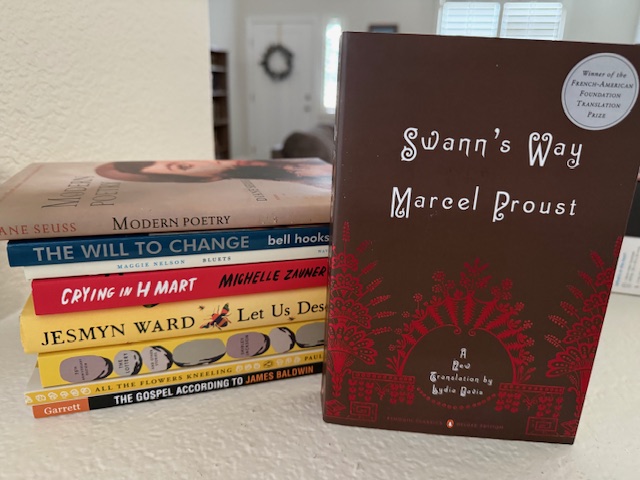
Since this work is such a long one, and because we’re collaborating with others on this particular read, we’re going to spread it out over two months; another first for this project! I usually try to keep books at/under 300-pages, so they’re manageable in one month’s time, but it’s exciting to switch things up a bit every now and again, and to bring some contemplative love to the “chunkster” classics.
Description: “Swann’s Way” by Marcel Proust is a novel written in the early 20th century during the modernist literary movement. This book is the first volume of “In Search of Lost Time” and delves into themes of memory, time, and the intricate layers of human experience. It primarily revolves around the reflections and memories of the narrator, often identified as Marcel, exploring his childhood, family dynamics, and his experiences with love through the character Swann. The opening of “Swann’s Way” presents a deep introspection of memory and the act of sleeping and waking. The narrator describes his experiences of falling asleep and the vivid dreams that intertwine with his memories of the past. A sense of dislocation and confusion emerges as the narrator oscillates between the present and snippets of vivid recollections, particularly of his childhood homes and family. He reveals a longing for his mother, highlighting a particular tenderness that ties into his overall theme of love and loss, setting the stage for the complexities of relationships that Proust plans to unravel as the narrative unfolds. —Project Gutenberg
About the author: Marcel Proust was a French novelist, best known for his 3000-page masterpiece À la recherche du temps perdu (Remembrance of Things Past or In Search of Lost Time), a pseudo-autobiographical novel told mostly in a stream-of-consciousness style.
Born in the first year of the Third Republic, the young Marcel, like his narrator, was a delicate child from a bourgeois family. He was active in Parisian high society during the 80s and 90s, welcomed in the most fashionable and exclusive salons of his day. However, his position there was also one of an outsider, due to his Jewishness and homosexuality. Towards the end of 1890s Proust began to withdraw more and more from society, and although he was never entirely reclusive, as is sometimes made out, he lapsed more completely into his lifelong tendency to sleep during the day and work at night. He was also plagued with severe asthma, which had troubled him intermittently since childhood, and a terror of his own death, especially in case it should come before his novel had been completed. The first volume, after some difficulty finding a publisher, came out in 1913, and Proust continued to work with an almost inhuman dedication on his masterpiece right up until his death in 1922, at the age of 51.
Today he is widely recognized as one of the greatest authors of the 20th Century, and À la recherche du temps perdu as one of the most dazzling and significant works of literature to be written in modern times. —Goodreads
Why Contemplative Reading?

Contemplative reading asks us not just what we’re learning about the book in our hands (or ears), but what we’re learning about ourselves through the experience of reading it. The aim is to create deeper awareness of ourselves and understanding of others. It is often described as “holistic,” but also as “heart-knowing.”
Heart-knowing. Doesn’t that sound nice?
The Plan
This weekly reading schedule is based on the Lydia Davis translation from Penguin Classics Deluxe. We’ll begin reading on February 1st and the first Instagram (IG) check-in will be Sunday, February 9th to comment on the first week’s reading (#ProustPilotProject). Since I do not participate on Meta apps (other than to post blog updates), I’ll be engaging here on the Contemplative Reading Project blog and will try to participate in both Zoom discussions.
- Week 1: Swann’s Way, to page 64 – stop at last full paragraph
- Week 2: Swann’s Way, to page 128 – stop at last full paragraph
- Week 3: Swann’s Way, to page 191 – stop at end of pt.I
- Week 4: Swann’s Way, to page 256 – stop at middle of page
- Week 5: Swann’s Way, to page 320 – stop at last full sentence on page
- Week 6: Swann’s Way, to page 382 – stop after end of first paragraph, mid page
- Week 7: Swann’s Way, to page 444 (end)
This schedule works out to about 9 pages per day. The Zoom discussion dates are planned for March 2 and March 30 at 1:00 p.m. Pacific (2 MT/3 CT/4 ET). Again, to be included in those Zoom invitations, you’ll want to reach out to Robin via her Instagram.
Reading & Responding
Each set of reading will guide my responses here on the blog and on social media. I will sometimes share the most provocative line or passage, and what it makes me think about. Other times, I’ll ask questions about the reading, things I’m wondering about or confused about. And still further, I might compare what I’m reading to what it reminds me of from other readings or experiences. I don’t want to give too much guidance about how to read, except to say, read attentively, read slowly, and listen to yourself. What thoughts and feelings arise as you’re reading? Write them down and give yourself some moments to reflect on why you’re thinking what you’re thinking, or why you’re feeling what you’re feeling.
I encourage you to join these conversations and leave your thoughts in the blog comments or on your socials. On social media, please use #theCRPblog and #ProustPilotProject.
Meditation
“Let us be grateful to the people who make us happy; they are the charming gardeners who make our souls blossom.” –Marcel Proust
With love,
~Adam

 Contemplative Reading Project
Leave a comment