
Dear Friend,
What If?
‘How does one say / what if / without reproach?” (5) Claudia Rankine’s Just Us: An American Conversation begins with a poem titled, “what if.” The tone sits on the edge of exasperation and determination. As she mentions in the next chapter, Rankine is motivated to talk to white people, especially white men, about racism. But there are so many “what ifs” to that goal. What if I speak to an ally who gets defensive? What if I speak to a racist who gets violent? What if I succeed? What if I fail? What if nothing changes? What if everything changes?
The poem speaks to the exhaustion of these questions and the never-ending need to ask them. “There is resignation in my voice when I say I feel / myself slowing down” (7), she writes, later adding, “what if what I want from you is new, newly made / a new sentence in response to all my questions” (11). There’s hope, still. Despite the exasperation, despite the exhaustion, despite the doubt that her readers, listeners, interlocutors will surprise her, she enters the conversation “without the shrug,” ready to try again. Because justice is worth it, and it’s just us who can create it.
Ethos
I think it’s important that a topic like this one begins with credibility. After the remarkable opening poem, Rankine pivots into her academic and professional history. “Liminal” explains the legwork she’s done in trying to understand the history of whiteness and racism, and how to teach it. Not only does she explain her rationale and provide insight into the goals she has with her students, but she also provides a reading list, which I find important to an argument. If I’m to understand you fully, I need to know how you came to understand, too. Some of her suggestions I’ve had the pleasure of reading–Toni Morrison’s remarkable collection Playing in the Dark, for instance, but the majority are new-to-me titles and authors that I’ll need to add to my reading list.
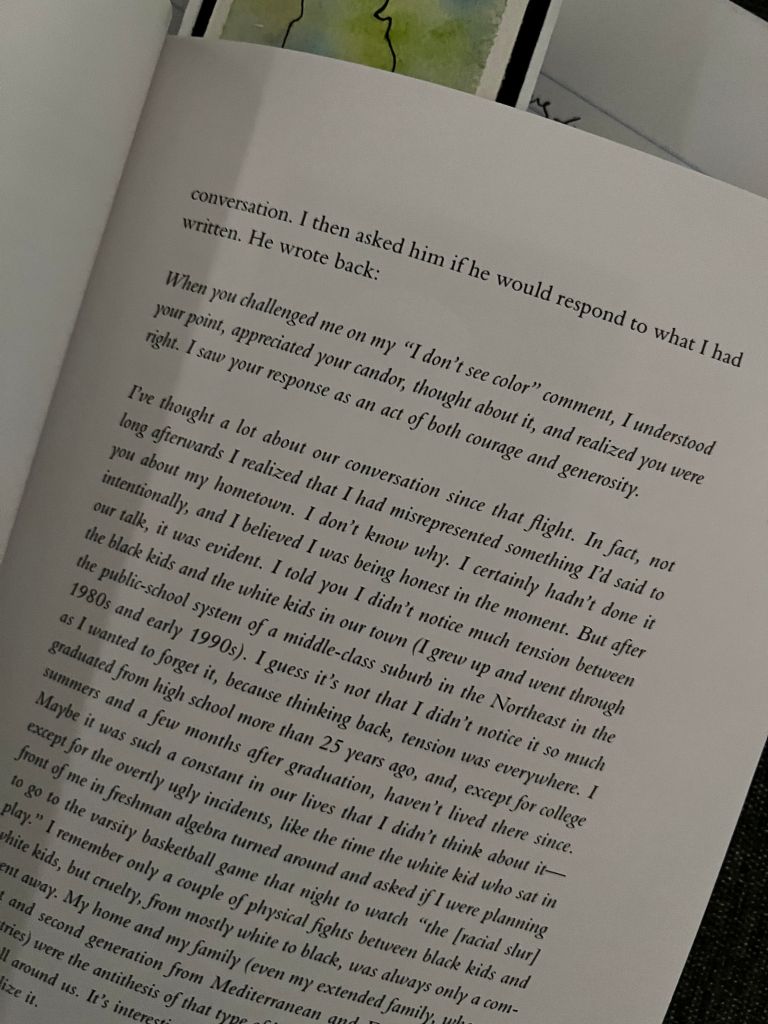
It’s important she lays all this out because it also leads directly into her project. The designing (and re-designing) of that college course inspired her to sit and think of the next step: “I wondered what it would mean to ask random white men how they understood their privilege” (19). The interviews and anecdotes, conversations casual and formal, then begin to be the evidence of her quest. Some of these conversations were rewarding and invigorating, even revelatory, such as the one excerpted in the image above, with a white man who seemed aware of his privilege, an agent for justice, and open to criticism, while other conversations seemed to go nowhere (though it’s hard to know for sure what happened with these people after they went on with their days and lives). It’s the fact of the questioning, though, the willingness to engage in the conversations, to instigate them knowing the potential dangers, that is impressive, just as impressive as any outcome could be. As Thich Nhat Hanh wrote in last month’s Zen and the Art of Saving the Planet, “in true dialogue, both sides are willing to change.” We must have brave dialogue if we really want to become unstuck.
White Living
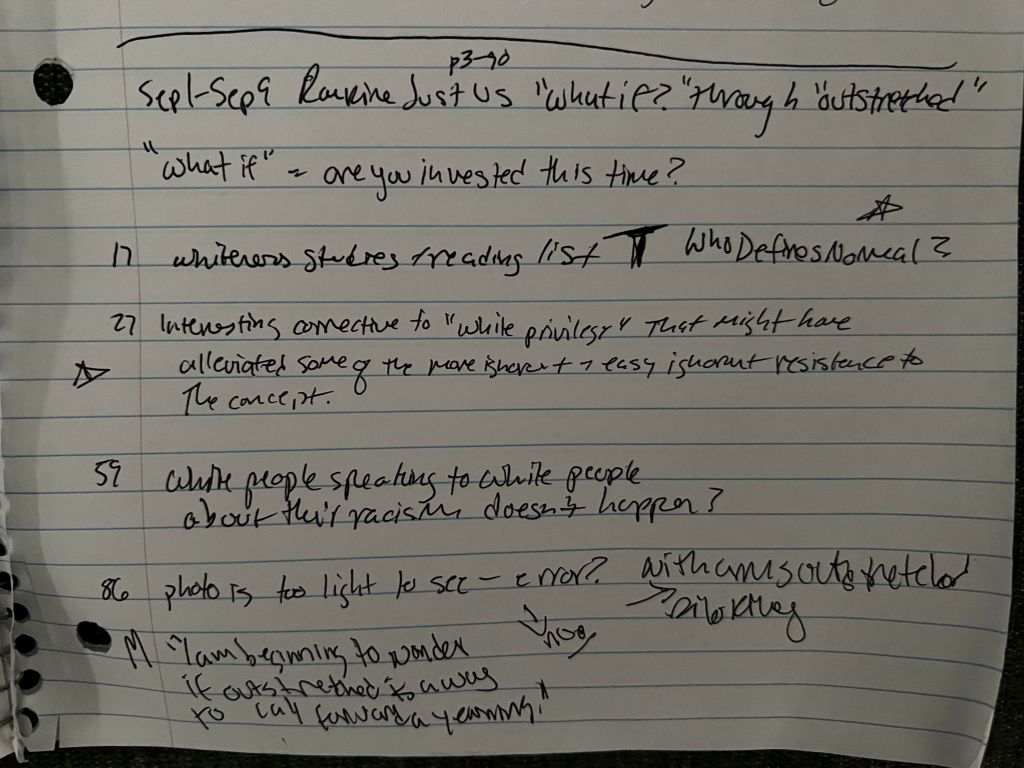
While explaining the term “white privilege” and its myriad misinterpretations and resistances, Rankine shares that it was a white woman, a Wellesley professor, who popularized the phrase. But Rankine makes an important point, which is that the language itself (what we sometimes call “rhetoric”) can make such a difference in how we respond to an idea. What if the term had been “white living” instead of “white privilege”? Might this have alleviated some of the sensitivity to the concept? The most common response to a charge of white privilege by any white person is probably, “privilege? I’ve worked hard to get here! Nothing was ever handed to me!” And so, the conversation, felt as an attack against the self, ends before it begins. As Benjamin Alire Sáenz wrote, “to be careful with people and with words is a rare and beautiful thing.”
The reading was not without its challenges for me. I questioned a statement in “evolution,” for example, that Rankine reports her friend making. White people don’t talk to their white friends about their racism. This just hasn’t been my experience, I thought, and I wondered if we were entering the realm of exaggeration or speculation. But just a paragraph or so above this section, Rankine writes, “I feel race relations and differences are more complicated than simply an ignorant dynamic I resent being party to” (59). It’s impossible to really know what’s going on beyond my experience, and while I know my immediate circles have been having the conversations, it’s not hard to imagine there are many–probably most–circles who are not.
“I am beginning to wonder if outstretched is a way to call forward a yearning,” Rankine muses. To lean forward is to put into physical motion the desire for change. To move. To act. To engage. If we desire change, if we desire justice, if we believe that justice has been lacking and we want that lack to be satisfied, then we must do the work of stepping forward into dialogue and into difference. It is a commitment to “what if”.
Meditation
“When we define ourselves, when I define myself, the place in which I am like you and the place in which I am not like you, I am not excluding you from joining–I am broadening the joining.” -Audre Lorde
Love,
~Adam
 Contemplative Reading Project
Leave a comment